A Rainy-Day Plan for Reading Casino Displays
A rainy-day plan for reading casino displays helps you interpret one public message clearly, without entering restricted areas or treating promotion as fact.
The common mistake in reading casino displays is to treat promotional wording as neutral information. A rainy-day plan for reading casino displays can help you separate what a notice states from what it asks a reader to infer, without entering a gaming area or spending anything.
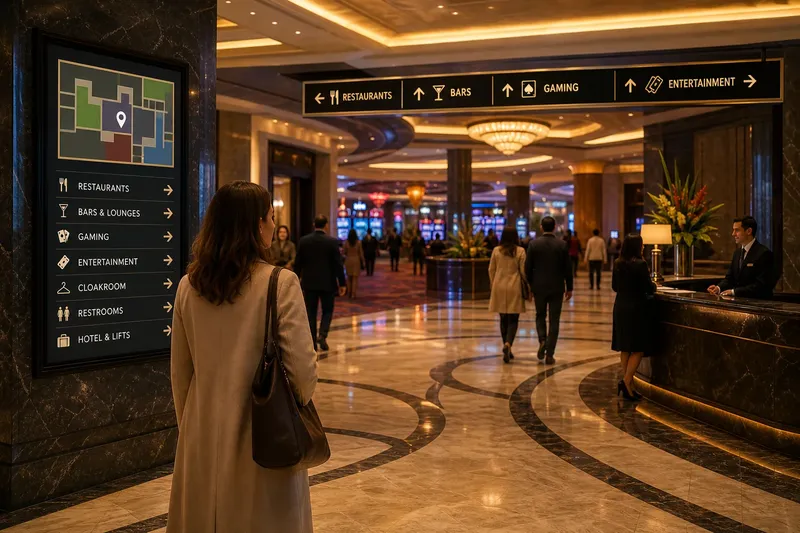
Choose one permitted public display and read it as a message with a purpose, not as a miniature tour of the venue. A hotel notice, public-facing event card or visitor map can all offer useful material. The subject is how the message works, not whether its offer is appealing.
How do you choose a display?
Start with the venue’s access rules. Select something visible from an ordinary public space, such as a hotel lobby or authorised visitor area. Do not enter a controlled space to get a better view. If observation or note-taking is not clearly permitted, ask staff or choose another setting.
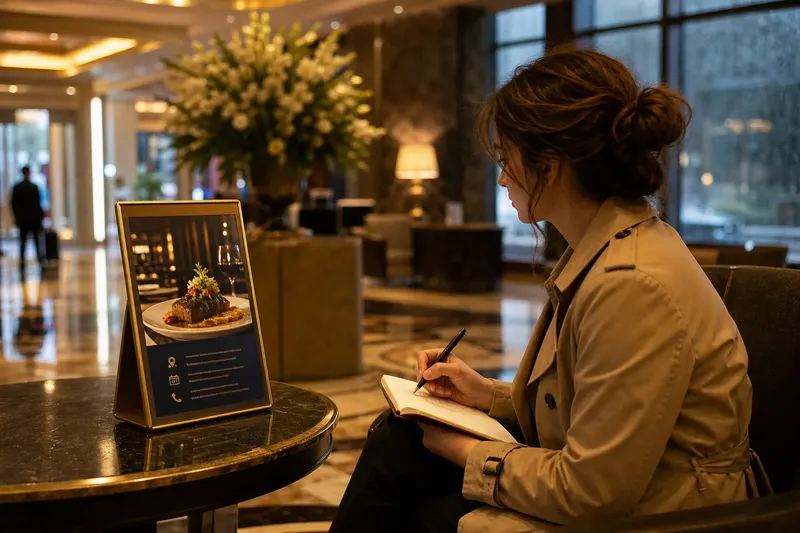
Choose a single item with enough information to examine: perhaps a printed event notice or a public map. Avoid photographing it unless the venue permits photography. You can make notes in your own words while keeping other visitors out of them.
Say you are waiting in a hotel lobby during rain and see a card advertising a dining event beside the public directory. You remain in the seating area, note the card’s headline and the location of its booking details, then leave without approaching a gaming space. The result is a bounded reading of one message, rather than an excuse to wander where you should not.
What does the wording actually say?
Record the headline, supporting line, call to action and named organisation, if visible. If a line is too small to read from where you are allowed to stand, mark it unreadable. Moving closer is not required for the exercise.
Sort the language by function. It might identify a place, explain an event, offer directions, invite a booking or describe a service. Direct verbs such as “ask” or “visit” tell readers what action is invited; broad mood-setting language may create an impression without specifying one.
Keep observation distinct from interpretation. “The heading names a restaurant” is observable. “The notice is intended for hotel guests” is an inference, which needs supporting clues elsewhere on the display.
How does the display guide attention?
Notice the order in which information appears. A large heading, photograph, logo and practical detail may compete for attention. Write down what stands out first and where a reader must look for the date, location, conditions or contact information.
A simple sketch of boxes in a notebook is enough to record the arrangement. Note contrast, spacing and whether text is legible from the permitted viewing position. The aim is not to grade the design. It is to describe what is prominent and what may be easy to miss.
A striking image can hold attention while leaving a date or condition less visible. Record that difference without claiming to know whether the display succeeds with its audience.
Who seems to be the intended reader?
Audience clues often sit in vocabulary and assumed knowledge. References to check-in, a concierge or a hotel restaurant may point towards overnight guests. A public map showing entrances may serve people who have just arrived. A formal event notice may address organisers or business visitors.
Ask whether the message explains where to go or assumes readers already know the venue. A local place name without explanation, for instance, may be easier for regular visitors to understand than for newcomers.
State your conclusion cautiously. Write “likely audience”, then name the wording or context that led you there. A message can be visible to everyone while still being written for a narrower group.
What can you infer, and what remains uncertain?
Can you take notes if photography is not allowed?
Yes, if ordinary note-taking is permitted in that public area. Use your own wording and leave out personal information or identifying details about visitors.
How should you read promotional claims?
Report them as claims made by the display, not as independent facts. Separate the wording of an offer from the design choices that give it prominence.
What supports an audience judgement?
Look for clues in vocabulary, placement and assumed knowledge. Call your conclusion an inference and state which clues support it.
Can you do this without entering a casino?
Yes. A permitted hotel lobby, visitor information area or public exhibition may contain relevant material without requiring entry to a gaming space. The venue’s rules take precedence over the exercise.
Which details should you check before deciding what the message means?
- Access: Check whether the display is visible from a permitted public area; if it is, observe from there, but if access is unclear, ask staff or choose another display.
- Wording: Check whether the headline states a place, event or action; if it does, record that function, but if it is vague, note the ambiguity rather than supplying a meaning.
- Practical details: Check whether date, location or conditions are legible; if they are, note where they appear, but if they are not, mark them unreadable without moving into a restricted area.
- Visual order: Check what draws attention first; if the main practical detail is prominent, record its position, but if a picture or logo dominates, note what information may be overlooked.
- Audience clues: Check for references to guests, visitors or local places; if clues point to a group, describe it as the likely audience, but if clues conflict or are absent, leave the audience uncertain.
- Promotion: Check whether the wording makes an offer or claim; if it does, attribute it to the display, but if it cannot be verified from the sign, do not present it as fact.
For a compact reading, state what the display says, how it orders information, whom it may address and what remains unknown. The last point matters: a public notice cannot reveal its authors’ intentions merely by standing in a lobby.
A rainy-day plan for reading casino displays is most useful when it ends with a precise description rather than a verdict. Keep the note focused on the message, and leave the venue’s rules—and other visitors’ privacy—undisturbed.