How Casinos Became Part of the Destination Offer
Casino destination offers grew from gaming rooms into wider leisure businesses. Trace the historical shift through Atlantic City and Las Vegas.
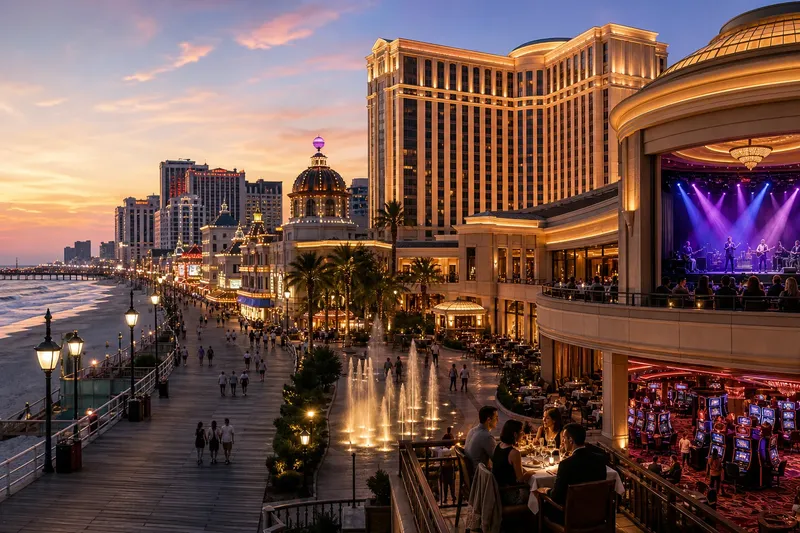
The common mistake in casino history is to treat the gaming room as the whole business. Casino destination offers took clearer shape as operators linked gambling with hotels, dining and entertainment, most visibly in Atlantic City and Las Vegas.
When did casinos become destination businesses?
There was no single moment when a gaming room became a destination. The change took different forms, shaped by local laws, transport and the businesses already serving visitors. Two American examples show how the idea developed without implying that every casino followed the same route.
Atlantic City was known as a seaside resort before casino gambling was authorised there in the late twentieth century. Its casinos entered a town with an existing leisure identity, hotels and boardwalk attractions. The commercial task was to connect gaming with that established visitor setting.
Las Vegas developed along a different path. Its casino hotels grew into large properties that combined gaming, accommodation, restaurants and entertainment under one operator or within a closely linked complex. The offer could centre on staying at the property, rather than relying chiefly on the attractions of a pre-existing resort town.
These examples are not a complete history of casino development. They show two distinct arrangements: casinos added to an established resort setting, and casino hotels built as integrated leisure properties.
How did Las Vegas change the casino hotel?
In Las Vegas, the hotel and gaming room could be parts of one commercial proposition. Accommodation made an overnight visit possible; restaurants and shows gave guests other reasons to remain at the property. The operator could coordinate the timing and presentation of these services rather than leaving every choice to separate businesses.
This arrangement also changed the scale of coordination. A hotel, restaurant and performance programme bring different staff, suppliers and schedules. The gaming floor may remain central, but it now sits within a business that must organise more than gaming.
Imagine a fictional casino hotel in Las Vegas that initially promotes its gaming room alone. Its management adds rooms, a restaurant and a booked music programme, then offers them as one visit. A guest can now arrange an overnight stay, a meal and entertainment through the property; the trade-off is that management must coordinate accommodation, food service and show schedules.
Why did Atlantic City’s resort setting matter?
Atlantic City’s casino businesses entered a place already associated with seaside leisure. That setting gave operators nearby attractions and established visitor infrastructure to work with, rather than requiring each property to create an entire holiday setting from scratch.
The relationship between casino and town could be less integrated than in a large casino hotel. A visitor might use the casino, walk the boardwalk or stay in separate accommodation. The destination offer therefore depended partly on connections beyond the gaming property itself.
This distinction matters to trade history. In one arrangement, an operator assembles much of the visit on site. In another, the casino becomes one participant in a wider local leisure economy.
What should you look for in a casino destination offer?
A destination label is a claim about the shape of a visit, not proof that a property provides every service or connects meaningfully with its surroundings. Check what is actually offered and decide how narrowly to describe it.
- Check whether accommodation is on site. If rooms are available through the property, include an overnight stay in the offer; if not, describe lodging as a separate local arrangement.
- Check the dining venues and their stated roles. If the property lists restaurants serving different occasions, mention dining as a distinct part of the visit; if it lists only a basic food outlet, keep the description narrow.
- Check the entertainment calendar. If performances or events have their own programme, count them as a separate reason to visit; if no programme is listed, do not present entertainment as a main attraction.
- Check whether event spaces are described for meetings or social gatherings. If those uses are explicit, recognise a group or business audience; if they are not, do not infer one from the building’s scale.
- Check how the property describes transport and local access. If it names connections to nearby attractions, include that relationship; if it only explains access to the casino, avoid claiming a broader local itinerary.
- Check whether nearby businesses and attractions appear in the visitor information. If they are named, describe the property as linked to local activity; if they are absent, do not assume the casino directs guests into the surrounding area.
What do readers ask about casino destination offers?
Does a casino destination offer have to be a resort?
No. A city casino can combine gaming, dining and performances without being a resort. The question is whether it presents a broader visit, not what label appears on the building.
Did casino hotels replace standalone gaming rooms?
No. The development of integrated properties did not erase venues focused on gaming. It added another way to organise and sell a visit.
Why include entertainment for visitors who do not gamble?
It gives a group more than one shared reason to visit, even when its members want different activities. That can broaden the offer without making gambling the only activity available.
Does a large casino automatically count as a destination?
No. Size says little about the range of services or how they relate to the surrounding area. Look at the actual offer and the visitor journey it supports.
What changed in the business behind the visit?
Casino destination offers altered the boundaries of the business. A property with accommodation, restaurants and performances has to coordinate a more varied operation than a gaming room alone. In Atlantic City, the casino could draw on a resort town’s existing leisure setting; in Las Vegas, integrated casino hotels made the property itself a larger part of the visit.
For casino destination offers, the historical distinction is not simply that later properties had more facilities. It is whether the operator connected those facilities into a visit, and whether that visit relied on the property or on the surrounding place. That difference helps explain what the destination label says about a casino’s commercial role.