What a Casino Guest Journey Reveals About Service
A casino guest journey shows how arrival, orientation and service touchpoints can reduce confusion, make help easier to find and give visitors room to choose.
The most common service mistake in a casino is treating arrival as a doorway rather than the first part of the visit. A guest who cannot tell where to go, what is open or how to ask for help pays for that confusion in lost time and rising irritation. The casino guest journey is a useful way to see why each touchpoint deserves attention on its own.
What happens before a guest reaches the gaming floor?
The journey starts before the first table or machine comes into view. A visitor may arrive by taxi, on foot from a hotel, or through a shared entrance serving restaurants and event rooms. Each route brings a different question: Is this the right entrance? Where can I leave a coat? Is there a quieter place to wait for someone?
Good arrival service answers those questions without making the guest ask several people. Clear signs at the approach, a visible reception point and staff who can direct visitors in plain language all help. The aim is not to shepherd everyone towards gaming. A casino is also a place to meet, eat, attend a show or simply find a seat.
Staff presence matters, but it should be proportionate. A greeting can confirm that a guest is in the right place; an eager pitch can make a first-time visitor feel that a decision has already been made for them. A brief welcome, followed by room to look around, is often the more civil arrangement.
Notice where a guest pauses. If people stop at the same junction to inspect a map or scan for a host, that pause is useful evidence about the space. It may point to a sign that is missing, a choice that is unclear or a reception desk that is hard to distinguish from a queue.
Practical point: Walk the public route from the nearest transport entrance and note where a first-time visitor would naturally hesitate.
How can orientation make a large venue feel legible?
A casino floor can combine gaming areas, restaurants, bars, toilets, lifts, cloakrooms and event spaces in one busy plan. Guests do not need to understand the whole building. They need to recognise where they are, what is nearby and how to reach the place they came for.
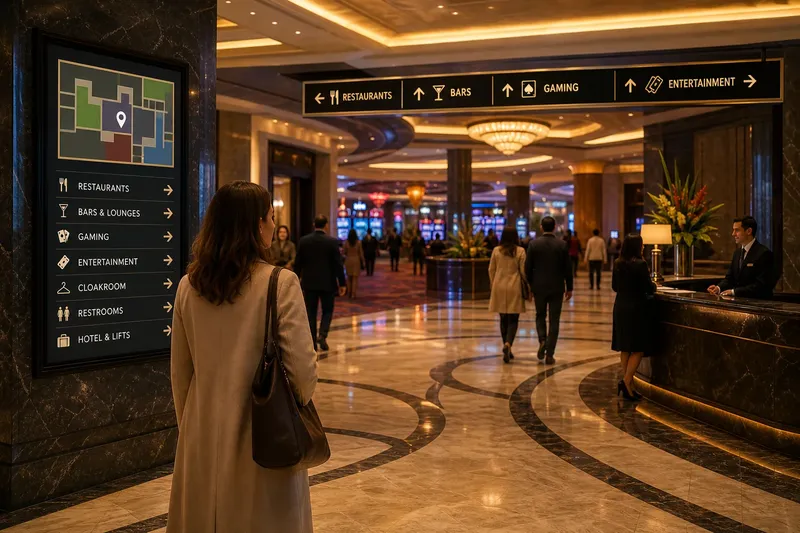
Signs work best when they answer a specific question at the moment it arises. A directory at the entrance can show the broad layout; a sign at a junction can identify the next turn. Repeating the same general welcome message at every point adds little. Directional wording should use names that match the venue’s maps and staff language, rather than an internal department label a visitor has never heard.
Maps should be readable at a glance. Keep the “you are here” marker obvious, show the main public destinations, and avoid giving a guest a diagram crowded with service corridors and back-of-house detail. If a route includes a change of level, make the lift or accessible alternative visible on the map and at the relevant junction.
Orientation also includes social cues. A greeter, host stand or information point signals where questions belong. If that point is hidden behind a promotional display, the venue has made help technically available and practically elusive. This is a distinction guests notice without needing to name it.
Say a visitor arrives for dinner with a booking and sees gaming tables before the restaurant signs. A clear directory near the entrance, followed by a restaurant marker at the next junction, gives that visitor a direct route without requiring a staff member to escort them. The expected result is simple: less hesitation, and a clearer sense that dining is a complete reason to be there.
Which service touchpoints deserve separate attention?
A guest journey is easier to improve when it is broken into moments rather than judged as one long impression. Each touchpoint has its own purpose, and the same staff behaviour will not suit every one.
- Arrival: Make the entrance, welcome point and available destinations easy to identify.
- Orientation: Provide directions and maps that use consistent names and show accessible routes.
- First request: Make it clear where to ask about bookings, facilities or venue rules, without forcing a guest to explain their whole visit.
- Service during the visit: Let staff respond promptly to a request while keeping interruptions measured.
- Transition: Show how to move between dining, entertainment and gaming areas, including routes back to public transport or the hotel.
- Departure: Make exits, cloakroom collection and transport information easy to find without sending guests back through a busy area unnecessarily.
These points are not a script. A visitor may skip most of them, while another may need several kinds of assistance. Treating them separately helps a venue see whether a problem belongs to the entrance, signage, queueing, staff handover or departure route, rather than calling everything “the guest experience” and leaving it at that.
There is a useful distinction between availability and interruption. A staff member who is visible and easy to approach offers service. A staff member who repeatedly solicits attention may take away the guest’s sense of choice. The right balance depends on the moment: a confused visitor benefits from an offer of help; someone reading a menu may not.
How should staff handle choice and boundaries?
Casino hospitality has a particular obligation to keep information clear and choice unpressured. Guests should be able to ask where facilities are, what a service involves and how to get assistance without being steered towards spending. A calm answer is more useful than a sales pitch dressed as a welcome.
Staff should explain venue processes in ordinary language and avoid implying that a guest must take part in gaming to use other facilities. Where a visitor asks about limits, breaks or support, the response should be discreet and direct. The venue’s relevant policies and locally applicable requirements should guide staff; questions involving legal obligations or a person’s welfare belong with qualified, designated support rather than improvised advice.
Privacy is part of the service, too. A guest may ask for help in a crowded lobby or near a table. Staff can offer a quieter place to speak where appropriate, without turning a routine request into a public conversation. Discretion should not mean vagueness: explain what can be done, who will handle it and what the guest may choose next.
Different visitors also bring different expectations. Someone attending a conference may want a quick route to the meeting rooms, while a couple meeting friends may need a clear rendezvous point. A visitor unfamiliar with the language may benefit from simple signage, translated essentials or a staff member who can communicate clearly. Service is not one polished greeting repeated at every face.
What questions do guests often ask about the visit?
Where should a first-time guest start?
Start at the main public entrance and look for a reception point or directory before choosing a destination. If the venue has several entrances, signs should make clear which one serves restaurants, events and other public areas.
How can a casino make directions easier to follow?
Use consistent place names across signs, maps and staff instructions. Put a directional sign where a guest must choose a route, rather than relying on a directory several corridors behind them.
What makes service feel attentive rather than intrusive?
Staff should be visible, approachable and responsive to a request, while allowing guests time to decide what they want. A brief offer of help is usually more comfortable than repeated prompts.
How can a venue support guests who do not want to game?
Show restaurants, entertainment, meeting spaces and public facilities as ordinary destinations, with clear routes that do not depend on entering a gaming area. Staff can answer questions about those options without attaching an invitation to gamble.
How can a venue learn from a difficult moment?
A complaint or visible hesitation can point to a specific service gap, but it should be read carefully. A long wait may come from a busy restaurant rather than a poorly placed sign; a guest asking for directions may simply be unfamiliar with the building. Record what happened in neutral terms, then look for the point in the journey where the guest needed information or support.
For example, imagine a guest arrives for a booked meal and asks two different staff members where the restaurant is. The first gives a department name that does not appear on the signs; the second points towards a lift without saying which level to choose. The expected observable result of revising the wording and adding a sign at the lift would be fewer conflicting directions on that route, not a claim that every guest will find the restaurant unaided.
Staff handovers deserve the same attention. If a host directs a guest to a cloakroom, the next employee should not need to ask the visitor to repeat the request. A short, appropriate handover can preserve privacy and avoid making the guest carry information from one department to another.
Use feedback to distinguish a one-off preference from a recurring obstacle. A guest may prefer a particular route; several guests stopping at the same unmarked junction suggest the route itself needs attention. Keep notes focused on the service point and the action considered, not on assumptions about the visitor.
What should a final walk-through include?
A walk-through is most useful when it follows the guest’s route rather than the staff’s usual circuit. Begin outside the entrance and continue through the public spaces a visitor might use. Notice sightlines, queues, noise, lighting and whether the signs remain visible when people gather nearby.
- Can a guest distinguish the public entrance from staff or delivery access?
- Is there an obvious place to ask a question without joining the wrong queue?
- Do signs identify toilets, lifts, dining areas, event rooms and exits at the points where choices arise?
- Can someone find an accessible route without needing to ask in front of a crowd?
- Do staff give directions using the same place names as the signs?
- Can a guest leave or reach transport without retracing an unnecessarily confusing route?
Check the route at different times of operation. A sign that is clear in a quiet lobby may disappear behind a queue or a temporary display later. The point is not to make every visit frictionless; a crowded venue will still be crowded. It is to avoid adding avoidable puzzles to the visit.
The casino guest journey is most useful when it keeps service specific. Arrival asks whether the guest knows they are in the right place. Orientation asks whether they can choose a route. A later touchpoint asks whether help is available without pressure. Keep those questions distinct, and small changes to signs, staff language and handovers become easier to judge. A guest should be able to spend attention on the reason for the visit, not on decoding the building.