Merchandise, Souvenirs and Gifts Have Different Jobs
Merchandise, souvenirs and gifts serve different visitor needs. Learn how to group casino shop products by purpose, describe them honestly and help visitors choose.
The common mistake with merchandise, souvenirs and gifts is putting them on the same shelf and calling them all keepsakes. That blurs what each item is for, makes the display harder to read and can leave visitors unsure whether they are buying something useful, a memory or a present for someone else. Merchandise, souvenirs and gifts need clearer roles in a casino shop.
These roles can overlap, but they are not interchangeable. Merchandise serves a use or identity; a souvenir records a visit or place; a gift is chosen for another person. Their materials may be alike, while their commercial purpose and presentation differ.
What does each category promise a visitor?
Merchandise is the broadest category. It includes branded clothing, drinkware, playing-card sets and other goods offered for use or display. A visitor might buy a logo hoodie because it is comfortable, signals an affiliation or simply suits them. The link to the venue may matter, but the item still has a job beyond recalling a particular visit.
A souvenir is tied more closely to a place, occasion or memory. A locally made ornament, a venue-specific postcard or a dated programme might be bought because it marks time spent there. Its value comes partly from the story attached to it, not only from practical use.
A gift is defined by its recipient and the act of giving. A visitor might choose boxed chocolates for a colleague or a scarf for a family member. The item could also be merchandise or a souvenir, but the buyer is considering how someone else will receive it. Presentation, suitability and ease of carrying all count.
These categories describe roles, not fixed product types. A ceramic mug can be venue merchandise if sold as a branded everyday object, a souvenir if it commemorates a particular place or event, and a gift if it is chosen for someone else.
How can a shop assign a clear primary role?
Start with the visitor’s likely reason for choosing the item. Then check whether the product and its display make that reason apparent. If more than one role fits, present the clearest one first rather than trying to give the item three equal identities.
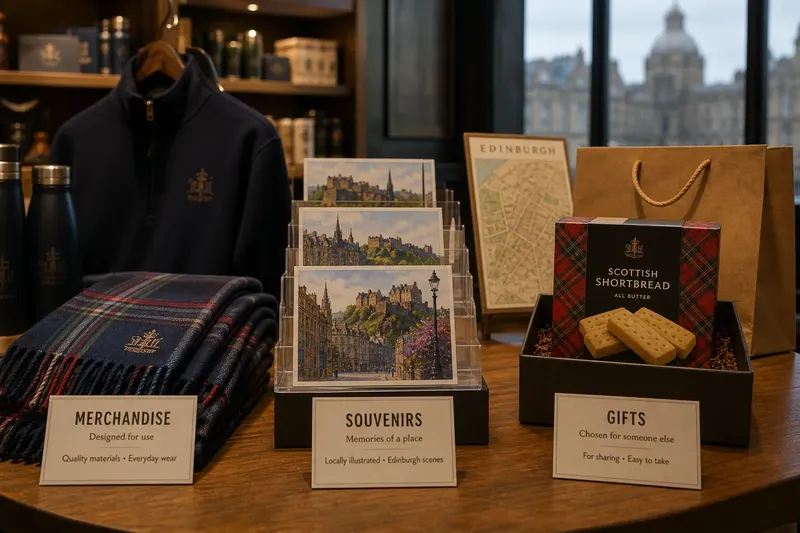
Imagine a hypothetical casino hotel in Edinburgh preparing a small display for visitors leaving after a weekend stay. It has a tartan-patterned scarf, a locally illustrated postcard set and a boxed shortbread selection. The shop manager takes these actions:
- Scarf: The starting input is a wearable item with a modest venue mark and visible care information. The manager groups it with clothing and describes its material and use; visitors can assess it as merchandise without mistaking the logo for the whole point.
- Postcards: The starting input is a set of Edinburgh illustrations with space to write or keep the cards. The manager places them beside a local map and names the illustrator if that information is verified; the place connection reads as a souvenir, not just generic stationery.
- Shortbread: The starting input is a boxed food product with its contents stated on the packaging. The manager presents it with a paper bag and a “for sharing” description only if that suits the product; visitors can judge it as a potential gift without being led to assume it is unique to the hotel.
- Display review: The manager checks each item’s label against its actual use, origin and packaging. If the description is accurate, it stays; if it implies an unverified local origin or special status, the manager replaces it with a plain factual description.
Say visitors keep picking up the postcard set, then putting it back while looking for something suitable to take to a host. The manager moves the shortbread beside a simple “for sharing” card and keeps the postcards near the local map. The expected observable result is a clearer distinction between a present and a place-memory, so visitors can browse without asking what each item is meant to be.
This arrangement is not a promise of higher sales. Its purpose is to make the choice easier to interpret and help staff explain the range without reciting every product detail.
What should the display make visible?
Presentation should follow the product’s primary role. Merchandise benefits from clear information about use, fit, material or design. A branded cap needs to show its shape and mark; a playing-card set should make its contents apparent. A logo cannot explain what an item is for by itself.
Souvenirs need a visible connection to a place or occasion. That might be a local maker’s name, a specific illustration or a concise description of what the item commemorates. Venue branding alone may show where an object was sold, but not why it is a meaningful reminder of the visit.
Gifts should be easy to assess as gifts. Packaging, a carry bag, a readable contents label and a suitable size can help. The item need not be ornate; it should make sense for the intended recipient and be presentable without the buyer improvising at the till.
For a mixed display, check each point and let the result guide the next action:
- Use: Check whether a visitor can see how the product works or is worn. If its use is clear, group it with merchandise; if not, add a factual use description or move it where the product can be examined.
- Place or occasion: Check for a verified local, venue or event connection. If one is clear, present the item as a souvenir; if not, avoid implying that connection and describe its other role instead.
- Origin: Check whether claims about a maker or place of manufacture are supported by product information. If confirmed, name the origin plainly; if uncertain, remove the claim and seek accurate details before restoring it.
- Contents: Check whether a buyer can tell what is inside, especially for food or drink. If the label is readable, keep it visible; if not, reposition the pack or add an accurate description based on its packaging.
- Presentation: Check whether the product is ready to hand to another person. If it is, a gift grouping may help; if not, make the packaging or carry option clear, or avoid presenting it as ready to give.
- Overlapping roles: Check which purpose the product communicates most clearly. If one role stands out, lead with it and mention the secondary role only when accurate; if none does, revise the display wording or grouping.
- Display language: Check that phrases such as “locally illustrated” or “boxed for sharing” match the actual item. If they do, use them; if not, replace them with wording that can be verified.
Keep the display readable from the visitor’s approach. A dense wall of logos can make merchandise feel repetitive, while a cluster of locally themed objects can obscure which items are suitable for giving. Separate shelves are not essential; distinct labels and sensible grouping may be enough.
Which role matters when an item could be all three?
A product can serve more than one role, so the shop should lead with the reason most likely to help a visitor decide. These common questions address where the categories overlap.
Can one item be merchandise and a souvenir?
Yes. A branded notebook may be useful merchandise and a souvenir if it has a clear connection to the venue or its location. Make that connection specific rather than relying on a logo alone.
When does a souvenir become a gift?
It becomes a gift when the buyer chooses it for someone else, though it can remain a souvenir by design. Packaging and a clear explanation of its place-based meaning help the buyer judge whether it suits the recipient.
Should a casino shop separate gifts from souvenirs?
Not necessarily. Group items by the decision a visitor is trying to make, using signs or short descriptions where categories overlap. Someone seeking a host gift may choose a local product, while someone looking for a personal memento may choose the same item for another reason.
How should a shop describe local products?
Use plain, accurate wording about the maker, origin or design. If an item is sold at the venue but not made locally, describe that distinction rather than implying a local connection.
What should staff check before changing the display?
Look at the product, the visitor’s likely purpose and the information currently visible. Then compare the wording with what is known about the item’s origin, materials, use and contents. Product labels, maker details and any relevant local requirements should guide claims.
The distinction between merchandise, souvenirs and gifts is useful because it makes the exchange more honest. Visitors can see what an item offers, and the shop does not have to ask a logo to explain everything. Use merchandise, souvenirs and gifts as a prompt to check whether each product’s purpose is clear before deciding where it belongs.